
Our health and wellbeing depend on the quality of the air we breathe, and pollution is becoming a bigger threat to public health. Air quality sensors are specialized equipment that can sense and identify various air contaminants and provide useful environmental data. Knowing the quality of the air we breathe can help us make sure the locations we spend our time are as healthy and beneficial as possible.
Therefore, we will examine the various types of air quality sensors that are available, how they operate, and why they are so useful in this post. We will also discuss everything from tracking dangerous gases to measuring particle matter. Let’s get started right now.
What is an Air Quality Sensor?
An air quality sensor is a device that measures and detects the amount of pollutants and environmental elements present in the air.
A few of the many variables on which it may gather data are:
- Temperature
- Humidity
- Carbon dioxide
- Carbon monoxide
- Ozone
- Formaldehyde
- Benzene
- Particulate matter
How Does an Air Quality Sensor Work?
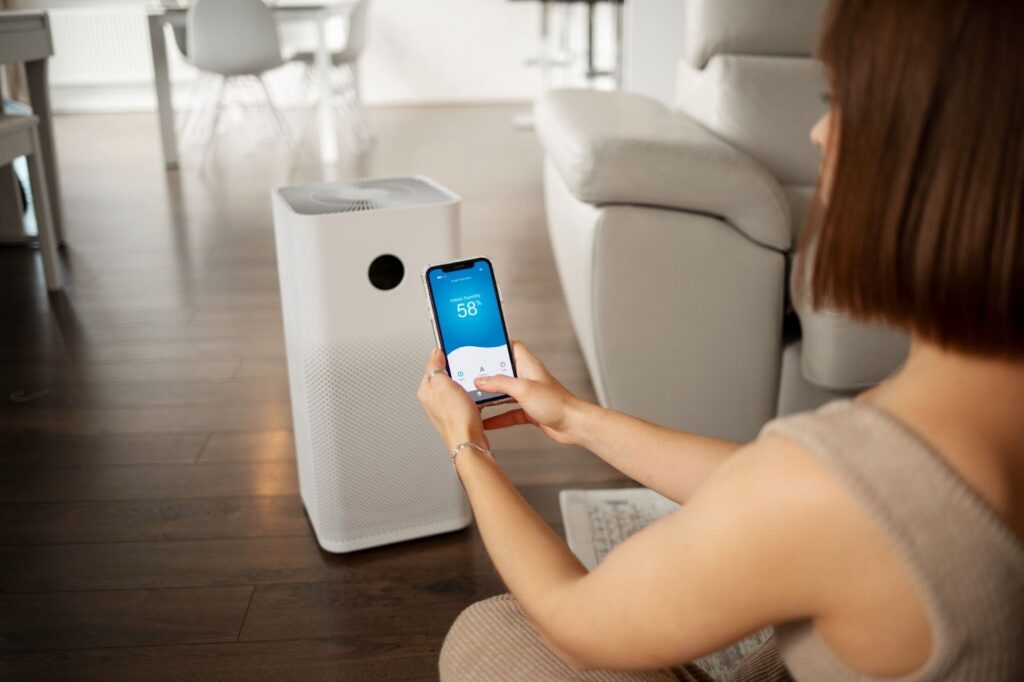
Air quality sensors detect and quantify the quantity of air contaminants, such as particulate matter, gases, and weather conditions, using a variety of sensors. It can provide a good image of the quality of the air when combined.
Air purifiers and fresh air ventilation systems typically incorporate air quality sensors. After that, they monitor the air quality in real time and can activate the air purifiers if the pollution level exceeds a predetermined threshold. They can also provide crucial details about the building’s operation and energy efficiency, which gives a positive impression of environmental sustainability.
Types of Air Quality Sensors
Each type of air quality sensor is made to identify a certain environmental parameter or contaminant. Now let’s examine a few of the most prevalent kinds:
Laser Scattering Sensors
These detect airborne particulate matter by observing how a laser beam reacts to airborne particles. In essence, the sensor measures the response when particles scatter or reflect laser light in order to calculate the particulate concentration.
Did you know that the least strict interim objective of 35 μg/m3 of PM2.5 pollution is exceeded by 36% of the world’s population? PM2.5 and PM10 particles may be picked up by air quality sensors. The sensors respond quickly and offer a large measurement range. They may be utilized for both outdoor and indoor air quality monitoring as well as industrial emission monitoring because of this and their great accuracy.
Electrochemical Sensors
These work by producing electrons through a chemical reaction between a gas and an electrode surface. Carbon monoxide, nitrogen dioxide, and other hazardous gases are among the gases whose concentrations are measured using this process. These sensors are very helpful in safety systems, such as gas leak and fire detectors, due to their great sensitivity.
Thermal Conductivity Sensors
These use the gases’ heat conduction characteristics to calculate gas concentrations. They detect heat flow using a thermistor and heating wire, after which they compute gas concentrations. The sensors are remarkably easy to use and provide fast and precise responses. They are typically used for real-time gas concentration monitoring in car and home air purifiers.
Optical Sensors
These sensors work by absorbing light. By observing how gas molecules absorb light at specific wavelengths, they are able to determine the quantity of gases. They can analyze multiple gas components simultaneously, are sensitive, and respond quickly. They are especially useful for monitoring industrial pollutants and both indoor and outdoor air quality.
For improved environmental health threat management, all of these work together to support an integrated air quality monitoring system.
The Advantages of Employing Air Quality Monitors
In terms of enhancing public health and reducing pollution, air quality sensors provide several benefits. When it comes to protecting people and the environment, they provide real-time data and intelligence that can improve decision-making.
Now let’s dissect a few of those advantages:
- Exposure monitoring: People can track their own exposure to dangerous contaminants using air quality sensors, which enables them to evaluate potential health concerns related to extended exposure to poor air.
- Predict health issues: Sensors that continuously monitor data on air quality can forecast the probability of allergies, respiratory illnesses, and other disorders, enabling early intervention and preventative actions.
- Save lives: During emergencies, air quality monitors can identify hazardous substances or gases in the atmosphere, such as carbon monoxide or poisonous fumes, and promptly issue alerts that may save lives by giving people time to take action or flee.
- Determine pollution sources: By identifying the precise locations and sources of air pollution, such as factories, traffic congestion, or other areas of environmental risks, the sensors enable the authorities to take appropriate action to reduce pollution.
Conclusion
At the end of the day, we all need clean air to breathe. If you want to know the AQI levels around you, try AQISCANR and take measurable steps to keep yourself safe.