

Air is something no human can live without. Literally, day in and day out, we breathe it without giving it a thought until all of a sudden, breathing becomes uncomfortable. Words such as air quality and air quality index would eventually become more meaningful to us. Most individuals use these terms interchangeably, but truth be told, they are different.
Understanding how air quality differs from the air quality index is like being one step ahead in safeguarding your health against the effects of pollution.
What Is Air Quality?
Air quality refers to the state or condition of the air around us in terms of how contaminated or pure it is. Clean air hardly contains harmful chemicals to humans. People who breathe polluted air might get allergens and other things that can make them feel uncomfortable.
The common air impurities are dust, smoke, motor byproducts, products of burning fuel, factory wastes, and gases produced from burning fuels. When we breathe in these particles and gases, they can penetrate our lungs. Exposure to air pollution commonly causes chest pain and coughing, and one experiences difficulty in breathing.
Children and old people with chronic respiratory diseases like asthma are usually the first ones to show these signs.
What is Air Quality Index?
Now let’s talk about what is air quality index.
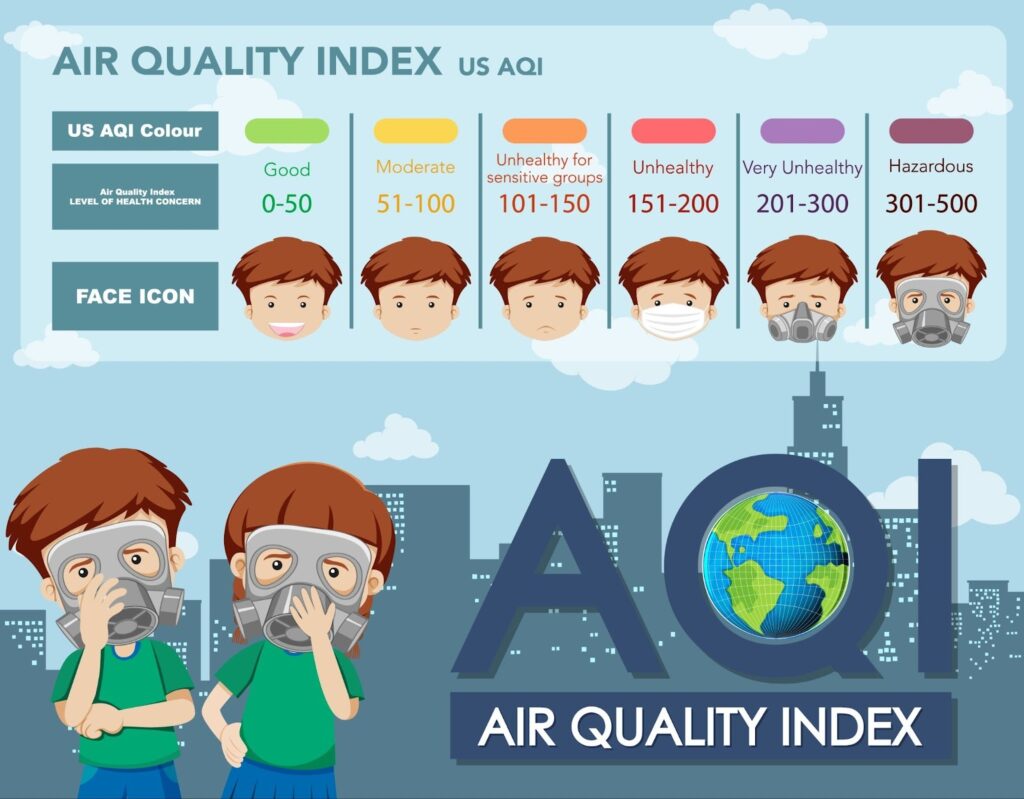
The air quality index (AQI) is a numerical indicator that communicates environmental pollution in a simple and straightforward manner. The AQI turns pollution data into a scale represented by numbers and colors instead of the text of the data itself. This is done to help everyone get a grasp of the safety of the air instantly.
An air pollutant concentration for a predetermined averaging period must be received from an air monitor or model in order to calculate the AQI. When combined, concentration and time indicate the air pollutant dose. The potency of air pollutants varies, and each pollutant has a different conversion function from air pollutant concentration to AQI. The values of its air quality index are usually categorized into ranges. A standardized public health advisory, a color code, and a descriptor are given to each range.
The standard AQI scale varies between 0 and 500. The low end indicates good air and high end indicates bad air with respectively low and high health risks.
You can see how good or bad the air is by looking at the colors.
For example:
- Green usually means good air
- Yellow means the air is okay, but not perfect
- Red means the air can be unhealthy
- Purple implies extremely hazardous air.
So, the short answer to what an air quality index is would be to say that it is a number of how good or bad the air is for human health.
The Difference Between Air Quality and Air Quality Index
The difference between air quality and air quality index essentially comes down to what you are referring to and how you measure it.
Air quality is literally the state of the air. It’s about what’s really there around you, such as dust, smoke, gases, and particles you can’t even see.
Another way to look at the difference between air quality and air quality index is this:
- Air quality is the state
- Air quality index is the score
Why the Air Quality Index Matters in Daily Life

Understanding what the air quality index is enables one to decide wisely on daily matters. For instance, parents may determine if it is safe for children to play outside. Outdoor games at schools may be called off. Elderly folks stay indoors when the AQI is high.
To avoid dangerous air when its quality is unhealthy, keep doors and windows closed, use air purifiers, and wear face masks. We suggest that you breeze there on a fresh, clean air day.
The AQI also helps governments and cities share clear warnings. They may denote the degree of threat by stating the AQI and not merely saying that pollution is high.
Final Thoughts
The air quality and the air quality index relate but do not substitute for each other. Air quality refers to how dirty or clean the air is. The air quality index is a way to convey the quality of the air using a number and colors that the general public can easily comprehend.
After grasping the concept of air quality and air quality index, checking air reports is no longer a task. Fresh air is a luxury we should not take for granted, and being able to interpret the signs correctly allows for easier breathing for all of us.
Visit AQISCANR to check and determine air quality more accurately and efficiently.